Ecodesign of plastics
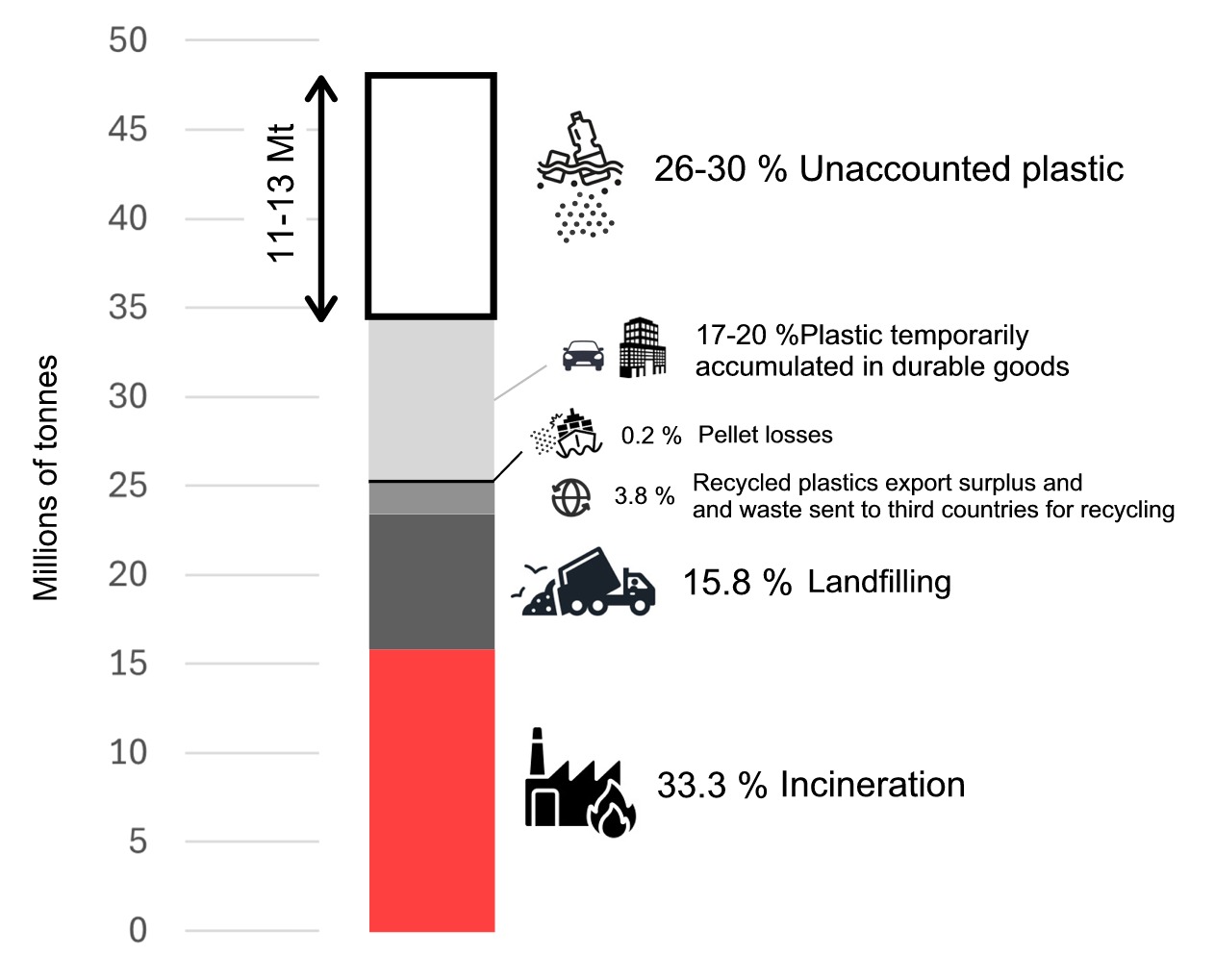
In the previous post, we saw that the European Union (EU27 + Norway, Switzerland and United Kingdom) produces over 40 million tonnes of fossil-based polymers each year for making plastic products. Of this amount, between 11 and 13 million tonnes are lost. That is, this is plastic that is not accounted for as waste, has not been exported, and cannot be assumed to be part of durable consumer goods that have not yet reached the end of their useful life. This leakage represents plastic out of control; most likely the same debris systematically identified in samplings performed across all environmental compartments.
The limits of recycling
The reasons why plastic escapes the recycling system fall into three categories: economic, logistical, and technical. The economic factor is easy to identify. The cost of virgin plastic is lower than that of recycled pellets, and in most cases, it is a higher-quality product, which reduces the incentives to recover plastic waste. This issue has commonly been addressed through subsidies for recycled plastics or by mandating minimum recycled content in specific products, as seen in EU Regulation 2025/40 on packaging and packaging waste. Logistical limitations refer to the lack of adequate collection, sorting, and treatment infrastructure, a situation that particularly affects developing regions, where plastic often does not even enter recovery systems.
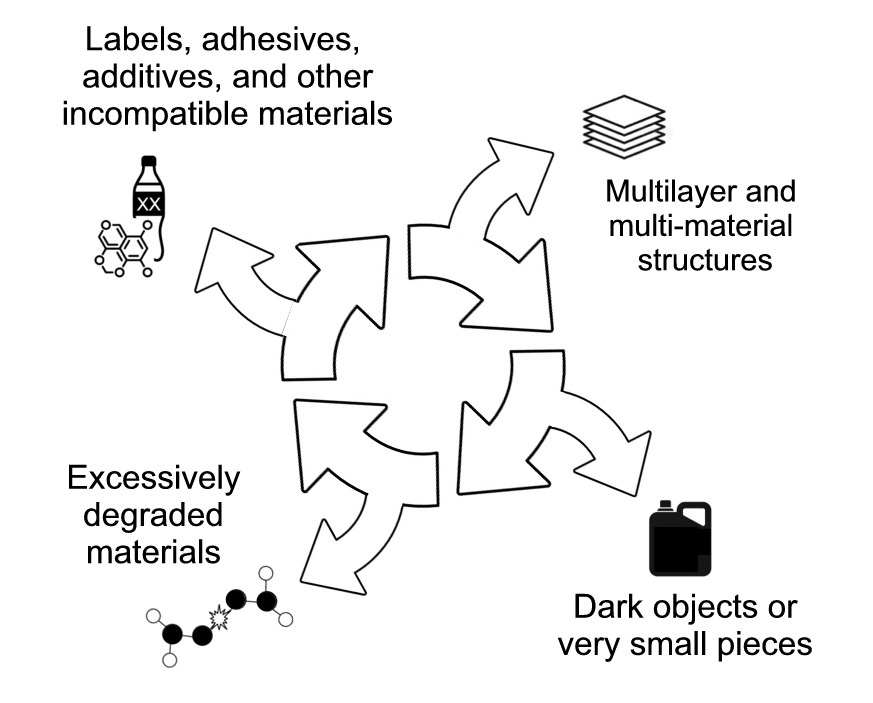
Technical limitations refer to barriers that hinder the reintegration of waste into the production cycle or compromise the integrity and quality of the resulting material. Plastic recycling depends heavily on the efficiency of separation and recovery processes, which are hindered because most products are designed for functionality rather than recyclability. The presence of multiple materials in a single product, especially in complex combinations like multilayer packaging complicates sorting and reprocessing. Furthermore, plastic waste is often contaminated with organic matter, labels, adhesives, or other non-plastic elements, which limits the quality and potential uses of the recycled material.
Currently, small, dark, or hard-to-sort plastics are either non-recyclable or entail prohibitive processing costs. Furthermore, certain additives, such as pigments, fillers, or flame retardants, degrade material quality and can even render mechanical recycling impossible. As a result, there is a technical limit given the current state of infrastructure and product design, which means that one-third of packaging and at least two-thirds of other plastic products are intrinsically non-recyclable due to technical or economic infeasibility, although in practice considerably less is recycled.
Furthermore, mechanical processing causes the progressive degradation of polymer properties, limiting the number of times a plastic can be recycled without significant loss of quality. Once this limit is exceeded, the material must be discarded or redirected to lower-demand applications, a process known as downcycling. A common example is polyethylene terephthalate (PET): when its polymer chains shorten to the point where blowing new bottles is no longer viable, the material can be reprocessed into textile fibers, where structural requirements are lower.
The simple option: don’t use plastic, use another material instead
One strategy to mitigate environmental impact is to substitute plastic with other materials, though this presents significant logistical and ecological challenges. Alternatives such as glass or metals are not only more costly but often have higher carbon and water footprints than the plastics they would replace. Furthermore, plastic is very difficult to substitute in critical applications. In the healthcare sector, plastic is irreplaceable due to its capacity for mass production, sterilization, and disposal, ensuring asepsis. In the food industry, its oxygen and moisture barrier properties are essential for extending shelf life and preventing waste, while its lightweight nature reduces transportation costs and emissions.
There are well-established mechanisms to reduce the consumption of virgin plastic, and some of these measures have been widely implemented in many countries, including the reduction or elimination of single-use plastic products. A classic example is replacing traditional polypropylene straws with paper or reusable alternatives. Another strategy involves substituting conventional plastics with biodegradable options for specific applications, such as agricultural mulch films. However, material substitution is a complex issue; it requires a comprehensive evaluation of the entire product life cycle, weighing factors such as energy intensity, weight, reusability, and recyclability.
Ecodesign for reuse, durability, and recycling
While necessary in certain cases, usage restrictions alone are insufficient to achieve a substantial reduction in the impacts associated with plastic. In this context, ecodesign stands out as a fundamental strategy by integrating environmental criteria from the very conception of the product. This approach constitutes the conceptual pillar of the Global Plastics Treaty, which addresses pollution through a comprehensive lifecycle perspective—from manufacturing to waste management. Within this framework, ecodesign emerges as the key tool for transitioning toward a circular economy, promoting safe, reusable, and recyclable products while reducing waste generation and environmental impact.
This strategy includes the design of reusable products, such as refill systems or returnable packaging. Another key strategy is the development of more durable products, as increasing a product's lifespan reduces the need for replacement and, consequently, waste generation at the end of its useful life. This is evident in the textile sector, with fabrics designed for multiple seasons or home textiles engineered for easy cleaning and repair. Furthermore, design optimization can decrease raw material input without compromising functionality, thereby reducing material consumption, transportation costs, and waste. A prime example is the evolution of PET (polyethylene terephthalate) bottles, where weight has been reduced by up to 50% due to improvements in geometry, base thickness, and thin-wall moulding technologies.
Many everyday materials are very difficult to recycle. This is the case for beverage cartons (composite packaging), where currently only the paperboard fraction is typically recovered, and dark-colored packaging, which is discarded before shredding due to the difficulty of being recognized by optical sorting systems. These technical hurdles drive high rejection rates in treatment plants, reaching 70% according to a 2021 study by OCU (Spanish Organization of Consumers and Users). Furthermore, contrary to popular belief, plastic items other than packaging are generally not recycled (with the exception of industrial plastics like greenhouse covers, which have specific management channels). This situation is common to many countries, to the point that the term wishcycling has been coined to describe the practice of depositing waste in the recycling bin in the hope that it will be recycled, when they are actually destined for incineration or landfills.
In a circular system, discarded products are a source of valuable materials. In this context, Design for Disassembly (DfD) becomes particularly relevant. This ecodesign strategy facilitates the separation of components and their recovery with sufficient purity to allow their reintegration into the production cycle under optimal conditions. Prioritizing products made of a single material (mono-material), or facilitating the disassembly of more complex ones, minimizes resin cross-contamination and simplifies end-of-life treatment. Currently, sorting systems can separate shredded flakes based on composition, though with technical limitations. Density-based processes are effective in specific cases, such as separating polyethylene or polypropylene caps from PET bottles. However, separation becomes technically and economically unfeasible when materials have similar densities, or when multiple polymers, additives, or contaminants are present.
Reduction of microplastic emissions and problematic additives
Another aspect of ecodesign focuses on minimizing microplastic emission during the product's use phase. A key example is the textile sector. where prioritizing dense weaves, compact yarns, and long fibers can mitigate the shedding of microplastic fibers (such as polyester and acrylic) during wear and washing. Similarly, in the tire industry, manufacturers are implementing solutions to reduce abrasion rate, a challenge exacerbated by heavier modern vehicles and anticipated regulations. The particles generated are a complex mixture of synthetic and natural rubber, chemical additives, and fillers like carbon black. This effort aligns with legislative frameworks such as Regulation (EU) 2023/2055, which bans certain products with intentionally added microplastics, such as cosmetics, detergents, fertilizers, or granular infill for artificial turf.
Finally, avoiding hazardous additives, such as phthalates used as plasticizers or brominated flame retardants, is fundamental, aligning with the regulatory framework of the EU's REACH Regulation in the European Union. The range of chemical substances added to polymers during manufacturing is vast, comprising thousands of compounds, many of which have incomplete or unknown toxicological profiles. This situation is exacerbated by the difficulty of monitoring global supply chains subject to uneven regulations. Once incorporated into the material, these additives can leach out progressively during the product's use or end-of-life. Since recovering them after release is technically unfeasible, the need for preventive action at the design stage is critical
Ultimately, plastic recycling faces structural limitations linked to product design, material complexity, and polymer degradation, preventing the loop from fully closing. Material substitution and usage reduction are partial solutions that are not always viable or environmentally preferable. In this context, ecodesign emerges as a key strategy by integrating criteria such as reusability, durability, recyclability, and disassembly from the conceptual phase. In summary, advancing toward a circular economy for plastics requires prioritizing action at the design stage to prevent impacts throughout the entire life cycle.